


LINX vs. Fundoplication: How Anti-Reflux Surgery Options Are Chosen
LINX and fundoplication both aim to strengthen the barrier against reflux, but they are not interchangeable. Learn which test results, anatomy, swallowing patterns, and personal goals help guide the conversation.
If you have ongoing heartburn or regurgitation, you may have heard about LINX and fundoplication. Both are anti-reflux operations. Both are intended to strengthen the barrier between the stomach and esophagus. Yet they do this in different ways, and neither option is automatically right for every person with symptoms.
The most helpful question is usually not, “Which procedure is better?” It is, “What is causing my symptoms, and which approach fits my body and goals?” Surgery selection requires a personalized evaluation and often objective confirmation of reflux. That means the decision is based on more than how often you feel heartburn.
Start with a clear GERD diagnosis
Heartburn is a symptom. GERD, or gastroesophageal reflux disease, is a diagnosis. Reflux-like symptoms can overlap with other conditions, and some symptoms outside the chest or throat may have more than one cause. For that reason, specialists take extra care before recommending an invasive treatment.
Your evaluation may begin with your health history, current medicines, symptom pattern, and any past testing. An upper endoscopy can look at the esophagus and stomach. Ambulatory reflux monitoring measures acid exposure or reflux events during daily life. Depending on the situation, a wireless pH capsule may be placed during an endoscopy, while catheter-based pH or impedance-pH testing are other monitoring options.
Esophageal manometry is a separate pressure test. It measures how the esophagus moves food toward the stomach. It does not place or guide a wireless pH capsule. Before anti-reflux surgery, high-resolution manometry is recommended to help rule out conditions such as achalasia or absent contractility, which can change the treatment plan.
Not everyone needs the same group of tests. The timing and type of reflux monitoring can also differ. For example, specialty guidance recommends testing off acid-suppressing medicine when GERD has not already been established, while impedance-pH testing on medicine may be useful for certain people with proven GERD and symptoms that continue despite treatment.
How fundoplication works
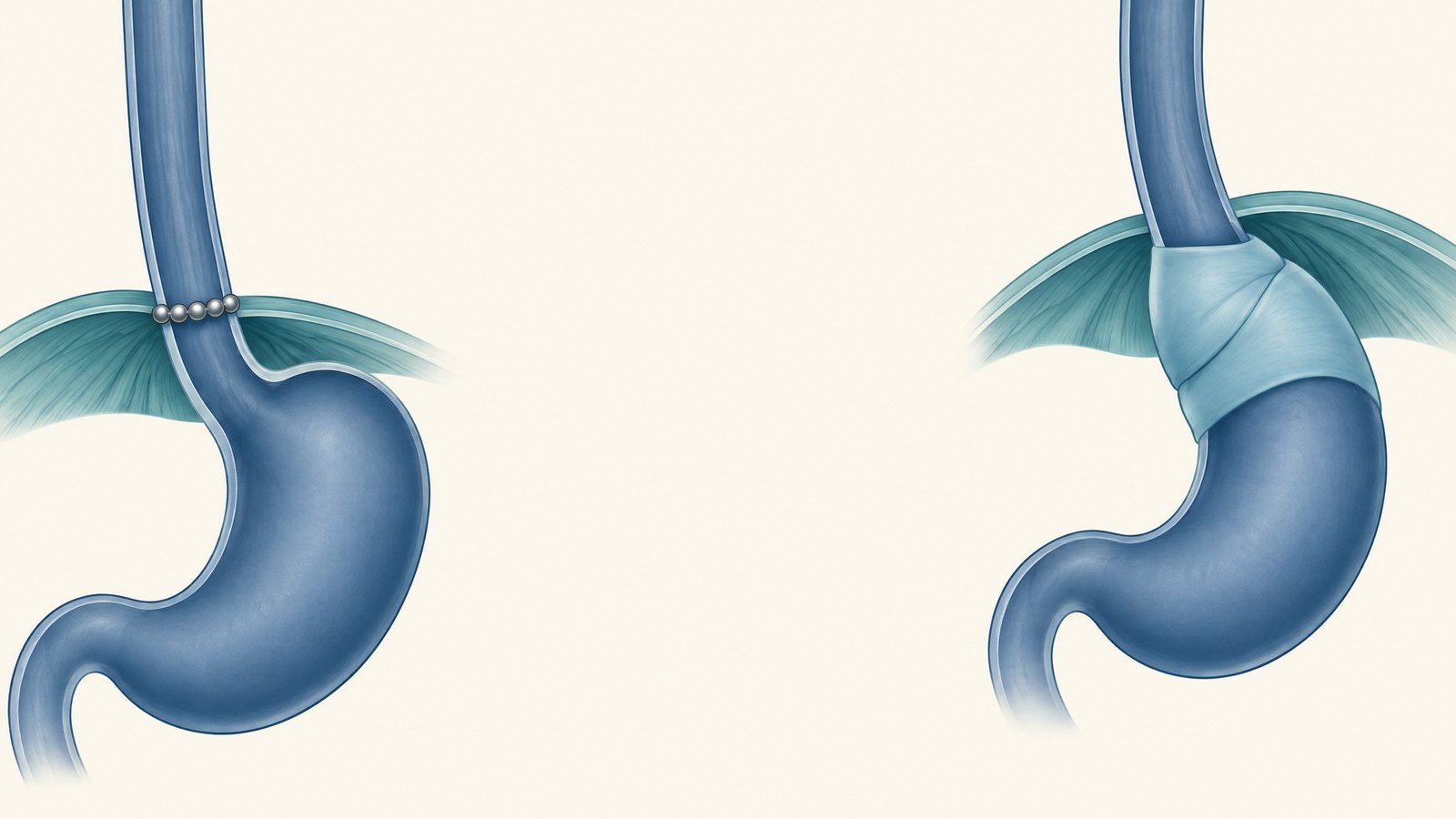
Fundoplication reinforces the anti-reflux barrier using your own stomach tissue. During the operation, the upper part of the stomach, called the fundus, is positioned around the lower esophagus. If a hiatal hernia is present, repair of that opening may be part of the same surgical plan.
There is more than one kind of fundoplication. A complete wrap, often called a Nissen fundoplication, goes all the way around the lower esophagus. Partial wraps, including Toupet and Dor approaches, cover less of the circumference. The choice is not simply a matter of choosing the strongest wrap. It is a discussion about reflux control, swallowing, anatomy, and what tradeoffs matter most to you.
SAGES guidance says either a partial or complete fundoplication may be appropriate for adults with GERD. A complete wrap may be favored when a person places higher value on reflux symptom improvement, while a partial wrap may be offered when avoiding swallowing difficulty is a higher priority. The evidence behind this comparison has limits, so an individual discussion remains important.
How LINX works
LINX is a form of magnetic sphincter augmentation, sometimes shortened to MSA. It uses a small ring of magnetic beads placed around the lower esophageal sphincter, the valve area between the esophagus and stomach. The magnetic attraction helps support closure of that valve area, and the ring is designed to expand when food passes through during swallowing.
LINX is an implanted device, not a stomach wrap. The FDA’s original approval order described the device for patients with GERD defined by abnormal pH testing who continued to have chronic symptoms despite reflux treatment. Current candidacy still depends on a clinician’s assessment of the complete medical picture, not a single test or symptom.
Specialty guidance recognizes magnetic sphincter augmentation as an alternative to laparoscopic fundoplication for selected people, particularly when regurgitation continues despite medical management. The multi-society SAGES guideline also states that either MSA or Nissen fundoplication may be used for adults with GERD through shared decision making between the patient and surgeon. Its comparison evidence was rated very low certainty, which is one reason it is important to avoid treating either procedure as a universal winner.
What helps choose between LINX and fundoplication?
A thoughtful choice brings several pieces together. First, the care team needs to know whether reflux has truly been documented and whether it matches the symptoms that most affect your life. Objective reflux monitoring is especially useful when the diagnosis remains uncertain. Stronger evidence of GERD on testing has been associated with more favorable symptom outcomes after anti-reflux treatment.
Next, anatomy matters. A hiatal hernia, the size and features of the opening in the diaphragm, and prior operations can affect how a procedure is planned. A hernia repair may be performed with an anti-reflux procedure when the surgeon determines it is appropriate.
Swallowing function is also central to the decision. Your surgeon will ask whether food feels slow or stuck and review manometry results. Those results do not choose a procedure by themselves. They help identify motility concerns and inform a safer, more individualized conversation about options.
Personal priorities count, too. Some people want to understand the differences between a device-based approach and a tissue-based wrap. Others have particular concerns about swallowing, gas and bloating, the ability to belch or vomit, recovery, or the possibility of future treatment. These are reasonable topics to raise. Each operation has potential side effects and complications, and some people may need additional treatment after surgery.
Finally, surgery is only one part of GERD care. Lifestyle changes and medicine may remain appropriate for many people. A consultation is not a commitment to an operation. Sometimes the best next step is more testing, medication adjustment, or treatment for another cause of symptoms.
Questions to bring to your consultation
A few clear questions can make the visit more useful:
• Has reflux been objectively confirmed, and do the results fit my symptoms?
• Do I have a hiatal hernia or a swallowing problem that changes the plan?
• Why might LINX, a partial fundoplication, or a complete fundoplication fit or not fit my situation?
• What short-term and long-term side effects should I consider for the procedure being discussed?
• What are the alternatives if I decide not to have surgery now?
The goal is an informed decision, not a fast decision. Your surgeon can explain the expected benefits, limitations, alternatives, and risks in the context of your test results and overall health.
A decision built around you
LINX and fundoplication are both established anti-reflux surgical approaches, but the best fit depends on the person. A careful evaluation can clarify whether GERD is the cause of your symptoms and whether surgery is appropriate at all. From there, your anatomy, esophageal movement, hernia findings, symptom pattern, and priorities can guide a balanced choice.
Want clearer answers about recurring reflux? Explore GERD and heartburn treatment at NorCal Integrity Surgery to learn how a personalized reflux evaluation can help identify the next reasonable step.
Medical disclaimer: This article is for general education and does not provide medical advice, diagnosis, or treatment. GERD symptoms can have different causes, and surgery is not appropriate for everyone. Discuss symptoms, test results, medicines, treatment options, and urgent concerns with a qualified clinician. Seek urgent medical attention for chest pain with activity, trouble swallowing or choking, vomiting blood, black or red stools, or unexplained weight loss.

