
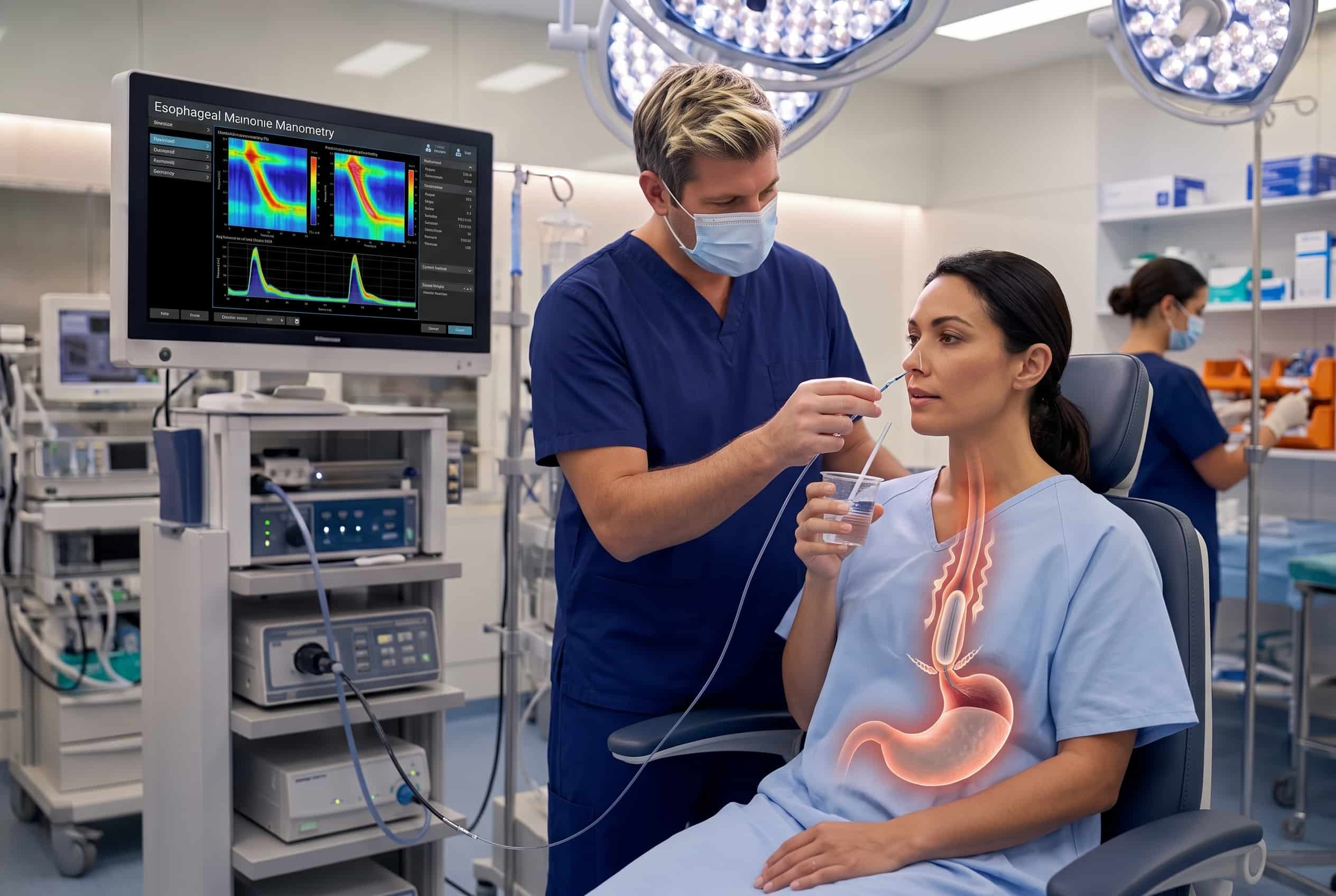


Esophageal Manometry
Esophageal manometry measures pressure and muscle coordination in the esophagus to help evaluate swallowing disorders, achalasia, and reflux surgery planning.
What is esophageal manometry?
Esophageal manometry is a specialized test that measures pressure and muscle coordination inside the esophagus. It helps evaluate how well the esophageal muscles move food and liquid toward the stomach. The test also shows how the upper and lower esophageal sphincter muscles open and close during swallowing.
At NorCal Integrity Surgery, Dr. Colin Dunn uses this test to help patients with swallowing disorders, achalasia, and reflux symptoms. It is also an important part of planning for anti-reflux surgery or hiatal hernia repair.

How it works
The test uses a thin, flexible catheter with pressure sensors to record how your esophageal muscles contract and how the sphincters respond as you swallow small sips of water.
What it measures
• Esophageal muscle contractions
• Pressure patterns during swallowing
• Lower esophageal sphincter function
• Upper esophageal sphincter function
• Types of movement patterns
What it tells Dr. Dunn
• Shows if swallowing waves are disorganized, weak, or abnormal
• Identifies problems like achalasia, esophageal spasm, or weakened swallows
• Helps determine if the esophagus has enough function to push food through a planned surgery
• Helps identify the location of the lower esophageal sphincter for catheter-based reflux testing
When is manometry used?
Esophageal manometry is recommended when symptoms suggest the esophagus is not moving properly or when surgery is being considered.
Manometry measures whether the esophagus is coordinating normally when food or liquid sticks in the chest.
It helps identify if the lower esophageal sphincter fails to relax properly, which is a key sign of achalasia.
It helps determine if the esophagus has enough function to handle a procedure like fundoplication or hiatal hernia repair.
What to expect
The test is performed while you are awake and usually takes about 10 to 30 minutes. You must not eat or drink for at least six hours before the test.
During diagnostic endoscopy
• Numbing medication is applied to the nose and throat
• A thin catheter is guided through the nose and into the esophagus
• You will take small sips of water while sensors record pressure
• You may feel brief gagging or nasal pressure during placement
• The catheter is removed immediately after the measurements are finished
During surgery
Esophageal manometry is not performed during surgery. It is a diagnostic test used before surgery to help Dr. Dunn plan the most appropriate and safe procedure for your specific needs.
While the test can feel unusual and slightly uncomfortable during placement, it is a brief procedure that provides vital information about your health that other tests cannot see.
Why this test matters
A normal endoscopy or X-ray does not always show how the esophagus is moving. Manometry provides information that visual tests cannot. This helps identify the correct problem so you receive the right treatment, especially since the treatment for a tight muscle is very different from the treatment for acid reflux.
Want to understand how this applies to your case?
Book a consultation and Dr. Dunn will walk you through exactly how EndoFLIP is used in your specific planned procedure.
Procedures and conditions
This test is often used for patients being evaluated for several conditions and surgical treatments.
Used in these procedures
• Achalasia
• GERD and chronic acid reflux
• Hiatal hernia repair planning
• Fundoplication surgery
• Evaluation of swallowing difficulty (dysphagia)
• Noncardiac chest pain
Not used in these procedures
Esophageal manometry does not replace an upper endoscopy or a barium swallow, as those tests look at the physical structure and lining of the esophagus. It is not used to guide the placement of a Bravo reflux capsule, which is performed during an endoscopy. The test may not be the next step if a patient has a narrow nasal passage or other health factors that prevent the safe placement of the catheter.
Frequently Asked Questions

Esophageal manometry is a specialized test that measures the pressure and muscle coordination inside the esophagus. It helps your doctor evaluate how well your muscles move food and liquid toward the stomach and how the sphincter muscles respond during swallowing. This evaluation is often used to identify swallowing and movement disorders or to plan for anti-reflux surgery.
You should not eat or drink anything for at least six hours before your test to help ensure accurate results. It is important to discuss all medications you are taking with your doctor, as some may need to be temporarily stopped. Please also inform the care team of any allergies or prior surgeries involving your nose, throat, or esophagus.
A thin, flexible tube is guided through your nose and into your esophagus while you are awake. You will be asked to take small sips of water so the sensors can record your muscle activity during swallowing. While you may feel some temporary pressure or irritation in your nose and throat, the measurement portion typically lasts about 10 to 30 minutes.
This is considered a low-risk test, though you may experience a temporary sore throat or minor nasal irritation afterward. Most patients can return to their normal activities immediately following the study and are typically able to drive themselves home. Your results are usually reviewed and available within two days to help guide your next steps. Please contact the office if you develop any severe or persistent symptoms after the test.

