
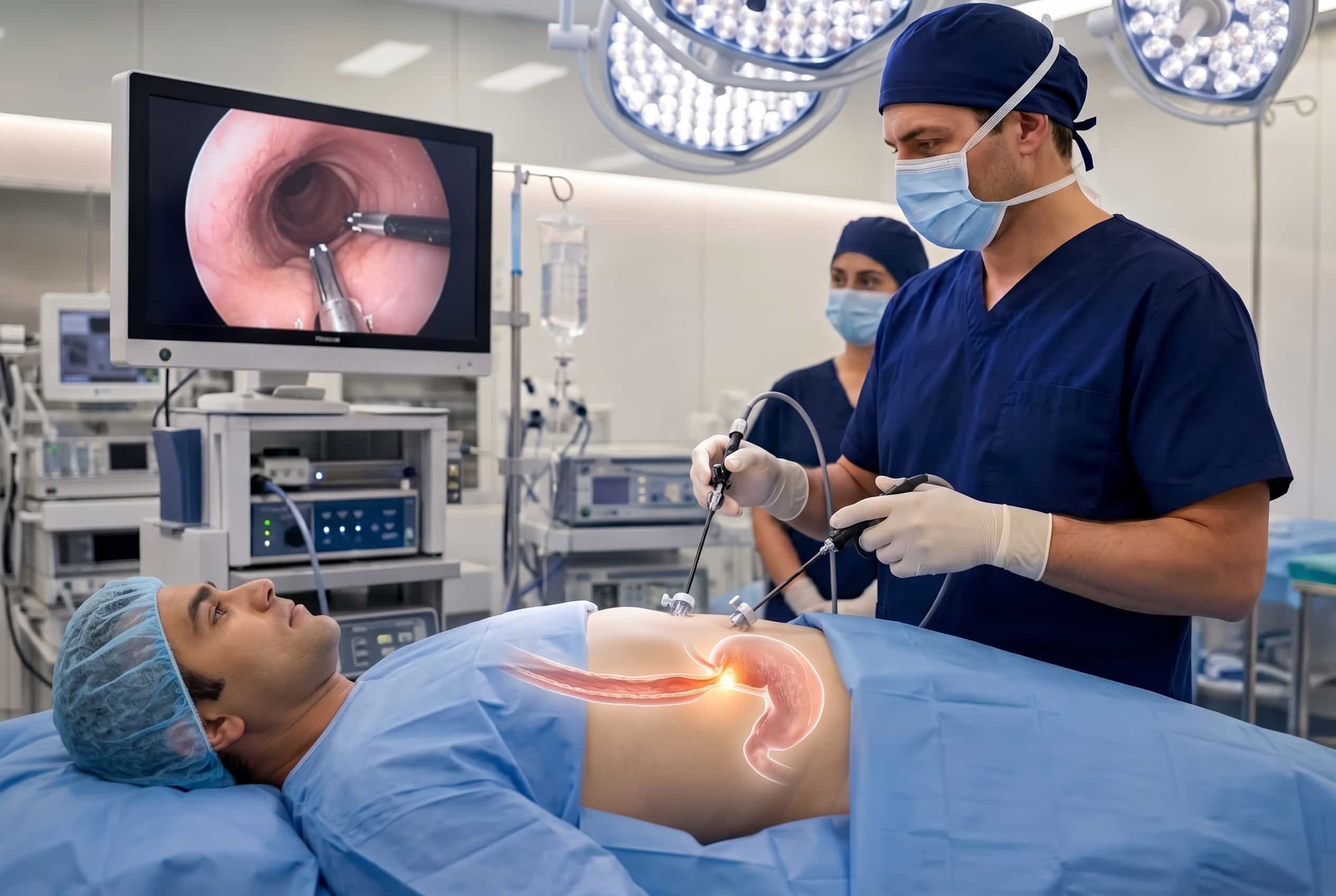


Esophageal Surgery
Esophageal surgery treats cancer, acid reflux, hiatal hernia, swallowing disorders, and strictures to restore the function of the esophageal tube.
About Esophageal Surgery
The esophagus is the muscular tube from your throat to your stomach. Esophageal surgery treats many problems of this tube, including cancer, severe acid reflux, hiatal hernia, swallowing disorders, and strictures. These operations can also fix Zenker’s pouch, a throat pouch that traps food, and address other complex upper digestive issues.

When is Surgery Considered?
Surgery is usually considered after tests clearly define the problem, as symptoms alone rarely decide the plan. Common situations leading to surgical discussion include esophageal cancer, progressive difficulty swallowing, Zenker’s pouch, achalasia, and complex strictures that do not respond to endoscopic treatments.
The Surgical Process
Esophageal surgery includes several types of operations tailored to the specific diagnosis.
A consultation finds a diagnosis and reviews your options. Surgery is not always the first choice.
For cancer, planning depends on tumor type and stage. Your team may recommend chemotherapy or radiation before surgery.
An esophagectomy removes the diseased part of the esophagus and rebuilds the food pathway, often using the stomach.
Minimally invasive techniques use smaller incisions and special instruments, which may reduce pain and incision size.
A feeding tube (J-tube) may be placed before or during surgery to support nutrition when oral intake is low.
Preparing for Surgery
Good planning matches the operation to the diagnosis. Tests vary by patient and are reviewed during the consultation.
Required before surgery
• Upper endoscopy (EGD) to evaluate the inner lining and tumors.
• CT scan of the abdomen and pelvis for staging and planning.
• Barium swallow or esophagram to show structural swallowing problems.
Sometimes also ordered
• EndoFLIP to see how the esophagus or junction opens and stretches.
• Esophageal manometry for muscle coordination testing.
• PET/CT, endoscopic ultrasound, or bronchoscopy for cancer staging.
Who is a Candidate?
Candidates for esophageal surgery are those with clearly defined esophageal issues that require surgical intervention.
Likely good candidates
• Patients with esophageal or gastroesophageal junction cancer.
• Individuals with progressive difficulty swallowing from tumors or movement problems.
• Those with Zenker’s pouch that traps food or raises aspiration risk.
• Patients with achalasia or severe motility disorders after muscle testing.
May need further evaluation
• Patients whose symptoms alone have not been clearly defined by testing.
• Individuals not fit for major surgery due to poor heart or lung function.
Not sure if you qualify?
Dr. Dunn reviews every case personally. Book a consultation and he'll give you an honest answer — even if that answer is "let's get more testing first."
Risks to be aware of
Esophageal surgery can be lifesaving but carries meaningful risks. Risk varies with procedure type, disease, age, and nutrition. Lung and heart health, diabetes, smoking, and prior surgery also affect outcomes.
Common short-term side effects (expected and temporary)
Expected in recovery
• Bleeding or infection common to major operations.
• Pneumonia or lung problems after chest surgery.
• Blood clots, which are managed with walking and medicine.
Serious risks (uncommon)
• Leak at a connection, which may need drainage or more procedures.
• Narrowing or stricture from scar tissue requiring follow-up.
What recovery looks like
Follow-up care includes long-term surveillance for cancer patients and personalized medication plans.
The operation is performed, and initial recovery begins in the hospital.
Hospital stay continues with pain control, breathing exercises, walking, and nutrition support.
Most patients stay in the hospital for five to seven days after minimally invasive surgery.
Recovery continues at home with swallow checks and gradual adjustment to diet changes.
Long-term diet changes include smaller, more frequent meals and careful chewing.
What to expect long-term
Many patients eat smaller, more frequent meals and may need long-term acid-reducing medicine like proton pump inhibitors to lower reflux and irritation risk. Cancer patients require long-term surveillance to monitor recovery and recurrence.
Questions about Esophageal Surgery

Esophageal surgery is often considered when non-surgical treatments are no longer effective for managing complex conditions. Doctors may recommend these procedures to treat esophageal cancer, severe acid reflux, or structural issues like a hiatal hernia. Surgery is also an option for swallowing disorders such as achalasia or a Zenker’s pouch, which is a throat pouch that traps food. However, surgery is not always the first choice. A surgical discussion usually begins only after diagnostic tests clearly define the underlying problem, as symptoms alone are rarely enough to decide on a surgical plan. If you experience a progressive difficulty in swallowing, a consultation with Dr. Dunn can help determine if surgery is the right path for your health needs.
Good surgical planning requires matching the operation to a precise diagnosis. Several tests are commonly reviewed to evaluate the inner lining, muscle coordination, and overall structure of the esophagus. An upper endoscopy (EGD) is central for diagnosing tumors and inflammation, while a barium swallow shows how food and liquids pass through the tube. Doctors also use esophageal manometry to check muscle coordination and CT scans for staging and planning. Beyond these diagnostic tools, your team will assess your nutrition and functional fitness, including heart and lung health. These evaluations help determine if you can safely tolerate the procedure. Bringing all previous reports, such as pathology or imaging results, to your consultation is essential for creating a personalized and effective treatment plan.
An esophagectomy is a major operation often used to treat esophageal cancer by removing the diseased portion of the tube. After removal, the surgeon must rebuild the food pathway so you can eat again. This reconstruction typically uses the stomach to create a new pathway, though the colon or small intestine is sometimes used instead. The specific approach, such as an Ivor Lewis or McKeown esophagectomy, depends on the tumor's location and your unique anatomy. In some cases, a minimally invasive approach using smaller incisions and specialized instruments may be appropriate. Regardless of the method, the primary goal is the complete removal of the disease while ensuring a functional pathway for nutrition. Your surgical team will discuss which technique best aligns with your diagnosis.
Recovery from esophageal surgery is a gradual process that requires careful planning and support. After a minimally invasive esophagectomy, patients often stay in the hospital for five to seven days to monitor for risks such as bleeding or infection. Nutrition support is a vital part of recovery, and some patients may need a temporary feeding tube, known as a J-tube, to ensure they receive enough calories. Long-term diet changes are common, requiring you to eat smaller, more frequent meals and chew your food carefully. Many patients also take daily acid-reducing medications to manage reflux. While surgery can be life-improving, it carries meaningful risks that vary based on your health. Your care team will provide personalized guidance to help you navigate these changes.

