
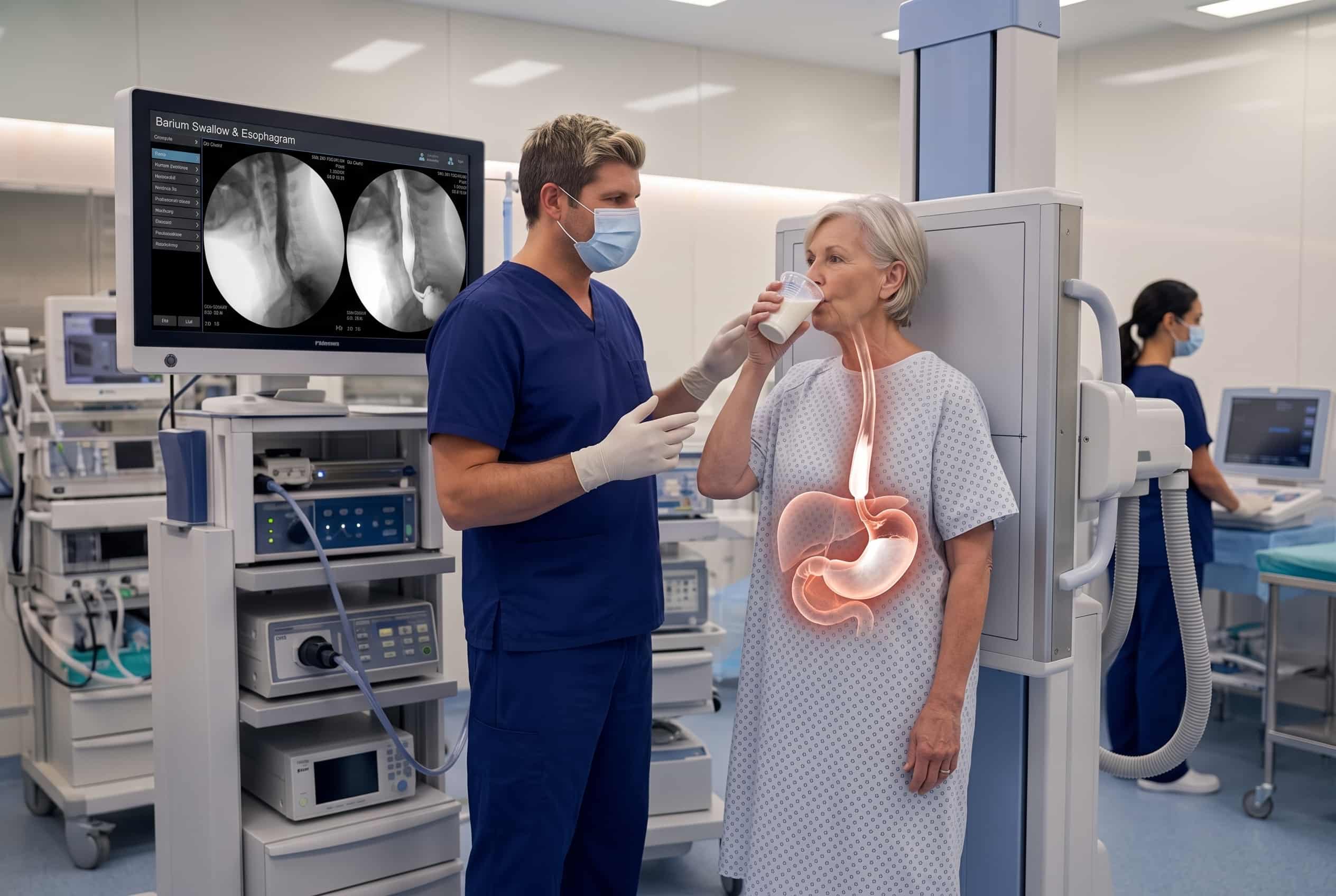


Barium Swallow / Esophagram
An esophagram is a moving X-ray test that helps doctors watch your swallowing in real time to find structural problems in your esophagus.
What is an esophagram (barium swallow)?
An esophagram, also called a barium swallow, is a special X-ray test that watches how you swallow. During the test, you drink a chalky liquid called barium. This liquid coats the inside of your throat and esophagus, which is the tube that carries food to your stomach. Because barium shows up clearly on X-rays, doctors can see the shape and movement of your swallowing tube on a screen as you drink.
This test usually uses fluoroscopy, which is like a moving X-ray movie. It helps the doctor see if food or liquid is getting stuck or moving the wrong way. While it shows the overall shape and motion, it does not show the fine details of the lining like an endoscopy does.

How an esophagram works
This test uses a special liquid and moving X-rays to create a live video of your swallowing process.
What it measures
• The shape and structure of your throat and esophagus
• How well your muscles move food and liquid toward your stomach
• The time it takes for liquid or solids to leave your esophagus (in special timed studies)
• Any unusual narrowing, blockages, or pouches in your swallowing tube
What it tells Dr. Dunn
• If there is a physical blockage or narrowing that makes swallowing hard
• If you have a pouch, like Zenker’s diverticulum, that is trapping food
• If your esophagus is not emptying correctly, which may suggest a motility problem like achalasia
• If part of your stomach has moved up into your chest, known as a hiatal hernia
• How your anatomy might affect the planning for a future surgery
When an esophagram is used
Dr. Dunn may use an esophagram if you have trouble swallowing, feel like food is stuck, or have symptoms of a structural problem.
It helps find why food feels stuck or why you might be choking or coughing while eating.
The test can find pouches, narrowing, or hiatal hernias that change the shape of your esophagus.
It provides a map of your anatomy to help Dr. Dunn plan for reflux or hernia repairs.
What to expect during the test
An esophagram is a non-invasive outpatient test that usually takes less than an hour.
During diagnostic endoscopy
• You will visit an imaging center, such as Valley Radiology, for the test.
• You must tell the care team if you are or might be pregnant, as X-rays can harm a developing baby.
• You will be asked to drink a barium liquid, which may have a chalky taste.
• A technologist will ask you to stand, sit, or lie down in different positions while you swallow.
• You may be asked to swallow a small barium tablet to help find areas of narrowing.
• You will stay awake and follow instructions throughout the 20 to 60 minute exam.
• You can usually go home and return to normal activities right after the test.
During surgery
This test is not performed during surgery. It is used before a procedure to help Dr. Dunn understand your anatomy and plan the best approach for surgery. It provides a moving map of your swallowing process that helps guide the surgical plan.
The test is usually not painful, but the barium liquid can have a chalky taste. You may feel bloated, have mild cramps, or experience constipation for a short time after the exam. It is also common to have white-colored stool for a day or two as the barium passes. Drinking plenty of fluids afterward is usually recommended to help the barium pass.
Why an esophagram matters
An esophagram gives Dr. Dunn a broad look at how your swallowing system works in motion. While it is not always the first test ordered, it is very helpful for seeing structural problems that other tests might miss. It shows the big picture of your anatomy, which helps the doctor decide if more specific tests like manometry or endoscopy are needed.
Because this test uses a moving X-ray, it captures problems that only happen while you are actively swallowing. This information is vital for creating a personalized treatment plan that fits your specific needs.
Want to understand how this applies to your case?
Book a consultation and Dr. Dunn will walk you through exactly how EndoFLIP is used in your specific planned procedure.
Which procedures use this?
An esophagram helps guide the evaluation for several conditions and surgical plans.
Used in these procedures
• Zenker’s diverticulum repair
• Hiatal hernia repair
• Anti-reflux surgery planning
• Evaluation for achalasia treatments like POEM or Heller myotomy
Not used in these procedures
An esophagram is not a routine test for everyone. It does not replace an endoscopy for looking at the lining of your esophagus, and it cannot measure muscle pressure as well as manometry. Even if your results are normal, it does not mean your symptoms are not real, and Dr. Dunn may still recommend other tests to find the cause of your problems.
Frequently Asked Questions

An esophagram, also called a barium swallow, is a contrast X-ray study that evaluates the structure and movement of the swallowing process. During the test, you drink a barium liquid that coats the lining of the throat and esophagus to make them visible on imaging. This allows your doctor to identify potential issues such as narrowing, pouches, or hiatal hernias while watching the digestive tract in motion.
Preparation usually involves fasting for a specific period before the appointment to ensure the upper digestive tract is clear. The care team may also ask you to avoid chewing gum or taking certain medications on the day of the procedure. You should inform your medical providers if you are pregnant or have concerns about recent radiation exposure before the test begins.
You will drink a chalky barium liquid while a radiology team uses moving X-ray technology called fluoroscopy to watch you swallow. This is an outpatient procedure performed without sedation, so you will remain awake and follow directions from the staff. You may need to change positions or hold your breath briefly to help the team capture clear images.
Most patients can return to their normal daily routine immediately after the study is finished. You might notice temporary bloating or white stool as the barium contrast material naturally passes through your body. It is often helpful to drink extra fluids following the procedure to help your system clear the barium more efficiently.

